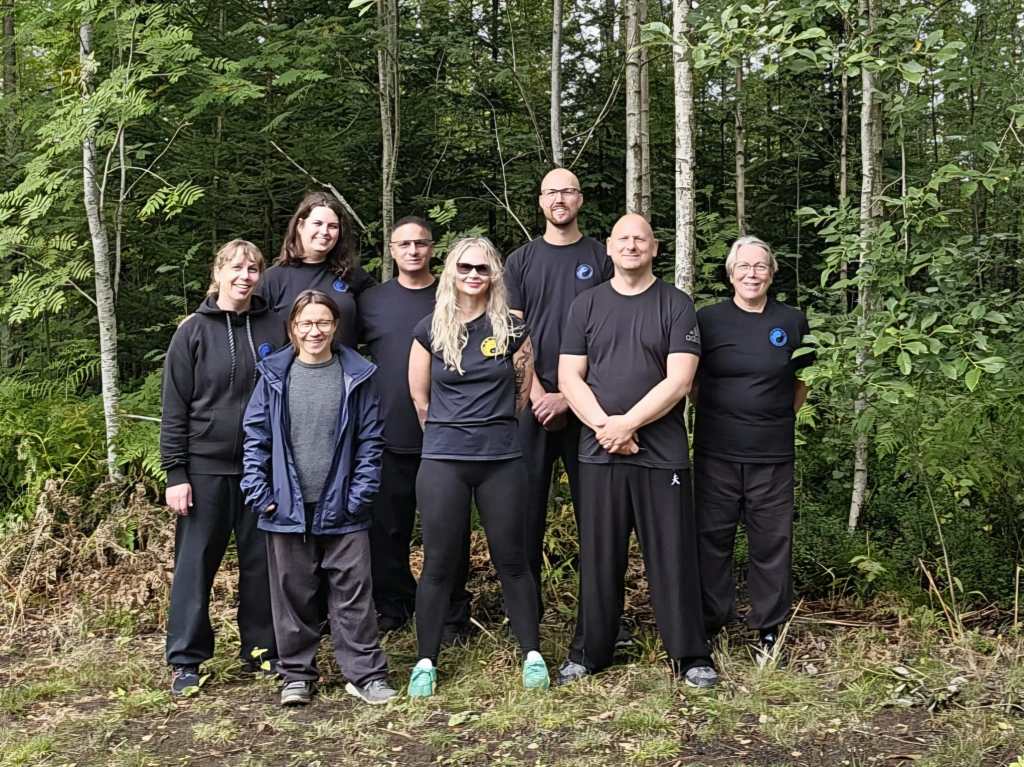
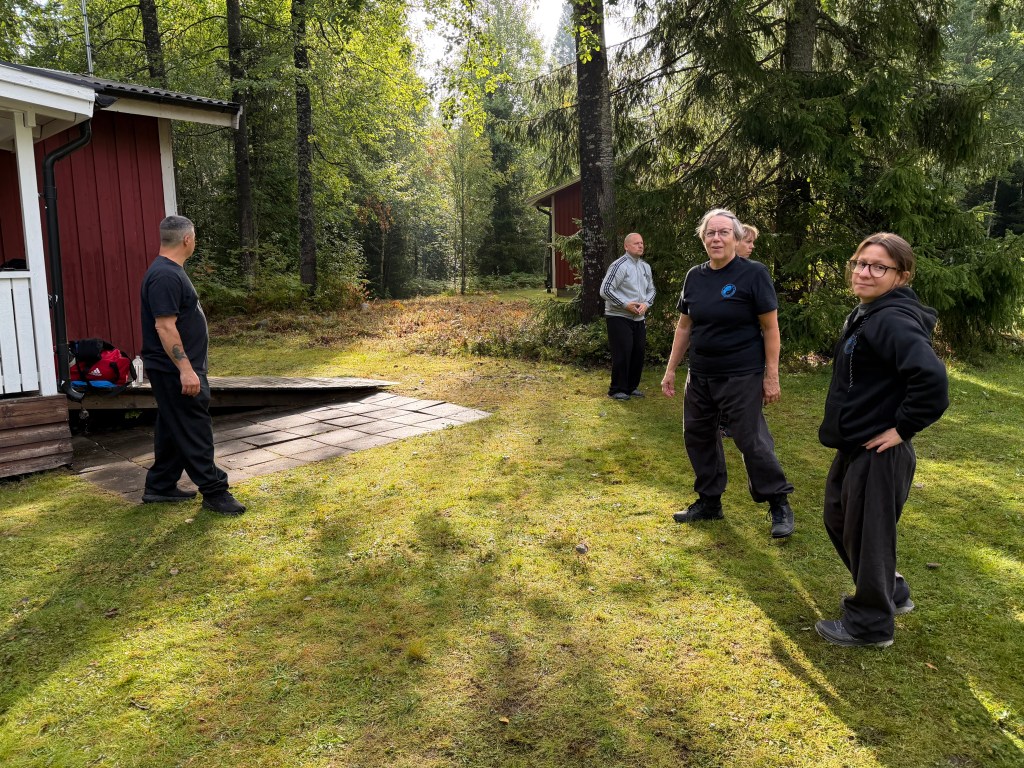
On Friday the 28th of August, after a week of labour, and a few weeks of daily life following the semester, it was finally time to go up to Ånnaboda in Kilsbergen once again, to enter the bubble of the annual autumn camp!
Just a few days before the camp weather forecast showed a 100% chance of rain during the weekend. After a few wet camps over the years, the gang was not even slightly concerned about that. “If it rains we train”, simple as that. I appreciate that attitude. It builds character – such a good character that the god of rain was humble enough not to soak us. Except during the night…
For this weekend I decided to sleep in my tent instead of in the cabins since it would probably be the last chance for me this season to sleep out in the wild. I know a few good spots close to the lake and I quickly put the tent up as soon as I got there, before the evening session began. With the forecast and the combination of total darkness up in the woods, I figured that doing it later in the evening could become an unnecessary project. It turned out to be a wise decision.
This was the third year in a row we arranged this camp, and with that comes more knowledge of how to put it all together. We began the first session on Friday evening: two hours as a little shakedown for the weekend, to get in the mood and clear the mind. The evening continued with great food, a hot sauna, good drinks and fruitful conversations. A refreshing walk back to my tent in total darkness and rain concluded the evening, and the sound of raindrops against the tent fabric put me to sleep.
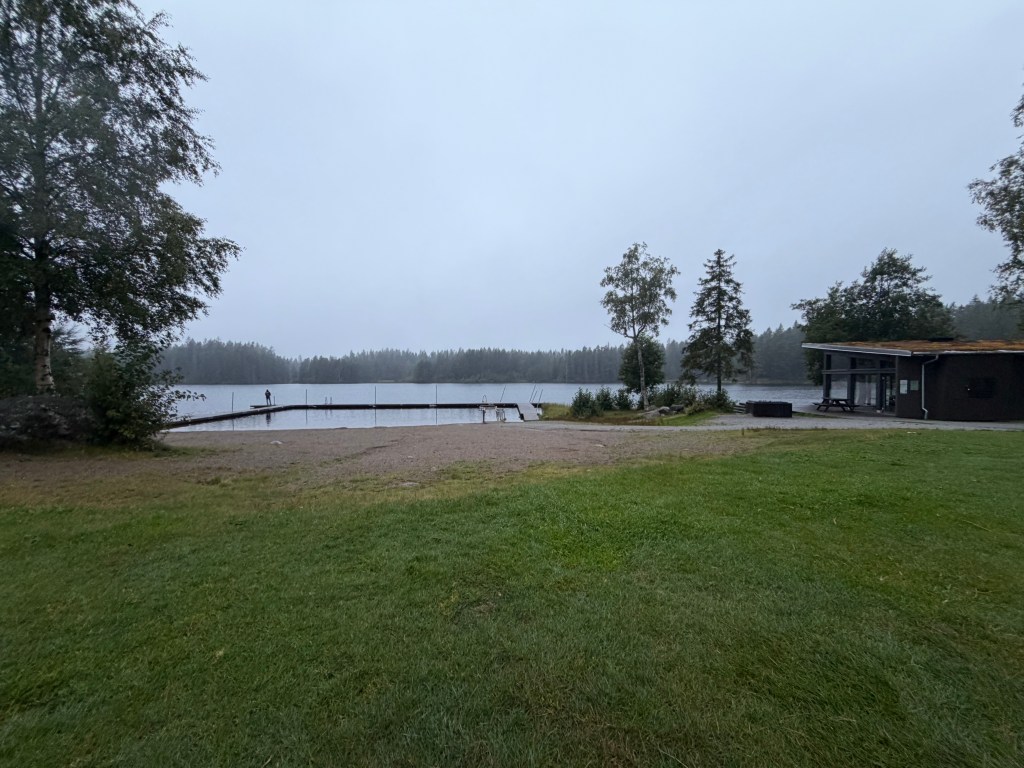
The thing that put me to sleep also woke me up in the morning, just at the right time, 6:30 a.m. Except for the rain, it was so quiet and peaceful. The fog was like a cover of clouds on the lake and the wild birds were circling over it, trying to find some fish beneath it. I took a morning swim in the fresh water followed by a walk back up the hill to meet up with the rest of the gang for the morning Nei Gong. During breakfast, after everyone at the camp had gone through the bacon and eggs part of the buffet, a young boy looked at us and told his father that the bacon was all gone, and when the father told the waitress, she got quite astonished. Apparently they’ve never done Nei Gong the first thing in the morning.
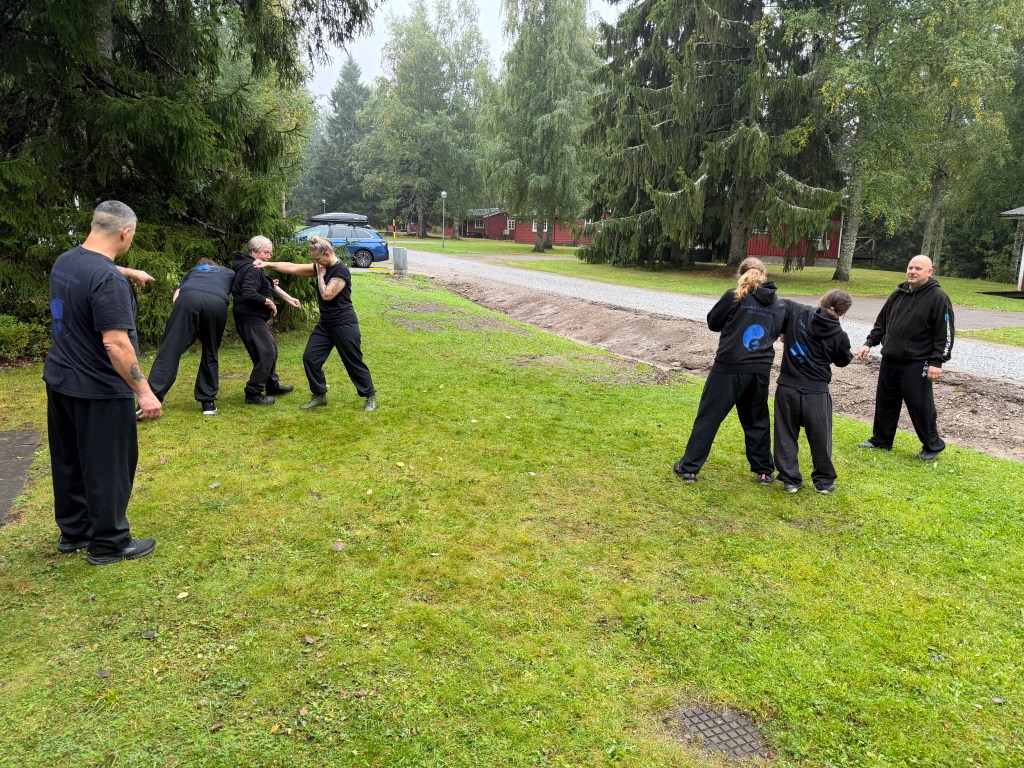
After the feast we all gathered again for the morning session. Saar had planned the days so that the morning sessions focused on hands only and the afternoon sessions focused on weapons. Saar has an amazing eye for posture, balance, and how to use the body correctly and efficiently. His attention to detail is remarkable: he notices even the tiniest deviations in your posture and helps you correct them.
What’s so fascinating, and what I’ve learned over the years, is that working with these small (or sometimes big) deviations and fixing them is like reprogramming the code in your body, so that the thing you had to correct gets permanently fixed in your code. A deviation in a specific movement usually isn’t limited to that movement. It’s how your body solves that problem every time, wherever it appears. When you reprogram the code, the body solves the problem differently — not just once, but permanently.
So after you’ve worked on a correction in one movement, repeated it numerous times, and got it right, you notice that something has changed in everything else you do: in forms, when you lift weights, when you spar, when you play with the kids. It’s corrected in every part of your life. Working with what can seem like small things can have a big impact.
With that being said, there is a great tool in our style for working with just that (among many other things): the square form. Compared with the round form, the square form breaks every movement down into smaller parts and is accompanied by a count: 1, 2, 3. Each count has a fixed starting point and a fixed end point. There is no way to get away with a deviant posture when you train like this. In the round form, which is always in motion, it is easy to “get away” with these things — you can fall into the next movement and compensate for bad posture or balance. You still can’t get away from Saar’s hawk eyes, but when you practice alone it is easy to move on to the next movement before the previous one is done correctly. In the square form you stop for a brief moment after every count, and if your posture is bad or your balance is off, you notice it immediately — hopefully.
The square form is something I’ve come to like more over the years, and I think that has to do with my knowledge and awareness improving over time. These subtle things make more sense and become more and more interesting.
Posture and using the body correctly and efficiently was a common thread through the entire weekend, whether we worked with hands or weapons. Saar always has the bigger picture in mind for a camp or a session, and his ability to actually see a person makes him one of the best guides you could have on this journey.
This training camp has become one of my favorite weekends of the year, and I already long for the next one. To leave society for a while and just be with friends, in nature, training — it’s the closest thing to monastic life I think I’ll ever have, and it fulfills a big part of my soul.